
SHORT ANSWER
Agentic AI means a language model plans steps, calls tools and acts on business systems instead of only answering questions. Most enterprise agents run at autonomy levels 1 to 3, where a person approves consequential actions. A production agent needs models, tools, memory, orchestration, guardrails, human approval points and observability. A first production deployment typically takes 8 to 16 weeks.
Your teams already use chat assistants. The next question is whether AI can do the work across your systems, not just talk about it. Agentic AI describes systems where a large language model plans a sequence of steps, calls tools such as APIs, databases and search, checks the results and keeps going until it reaches a goal. The value is automating multi-step knowledge work. The risk is that the system now acts, so mistakes have consequences.
This guide covers autonomy levels, use cases, a reference architecture and the controls that make agents safe to run. If the concept is new to you, start with what is an AI agent.
What are the levels of AI agent autonomy?
A useful way to scope an agent is to decide how much it may do without a person. Most production enterprise agents today sit at levels 1 to 3.
Level | What the agent does | Human role | Typical examples |
|---|---|---|---|
0: Assistant | Answers questions from provided context | Reads and decides everything | Policy Q&A, document search |
1: Recommender | Gathers data and proposes an action | Chooses and executes | Next-best action for service agents |
2: Drafter | Prepares the action ready to execute | Approves each action | Draft replies, prefilled tickets, draft purchase orders |
3: Supervised actor | Executes low-risk actions, escalates others | Approves exceptions, reviews samples | Ticket routing, data enrichment, invoice matching |
4: Autonomous | Executes end to end within limits | Monitors metrics and audits | Narrow, reversible back-office tasks |
Which agentic AI use cases come first, by function?
Function | Use case | Why it suits agents |
|---|---|---|
Customer service | Resolve order, billing and delivery queries across CRM, ERP and shipping systems | Several lookups and a clear resolution policy |
Finance | Invoice to purchase order matching, exception handling, month-end reconciliation | Rules plus judgement on unstructured documents |
Procurement and supply chain | Supplier onboarding checks, delay alerts with proposed mitigations | Combines external data with internal systems |
HR | Candidate screening support, onboarding workflows, policy questions | High volume, repeatable steps |
IT and operations | Incident triage, runbook execution, access requests | Well-defined tools and audit logs already exist |
Sales | Account research, proposal first drafts, CRM hygiene | Saves hours of manual preparation |
Data and analytics | Natural-language questions over governed metrics | Needs governed metric definitions to stay accurate |
Good first candidates share three traits: a measurable baseline (time, cost or error rate), data the agent can reach through existing APIs, and a clear point where a person can approve the result.
What we see in delivery: automate the plain steps first
A nonprofit human-services organization came to us with staff re-keying data from third-party systems into spreadsheets. We built an event-driven pipeline on Azure that collects and transforms that data automatically, with role-based access so staff only see the records their role allows. Machine learning models, called through APIs, give frontline staff recommendations in real time.
The estimated reduction in manual data entry time was 60 to 80 percent, and most of it came from plain automation, not from the model. That’s the lesson we bring to agent projects: put deterministic steps in code first, then use the model only where a decision needs judgement.
What does a reference architecture for enterprise agents look like?
A production agent is a software system with an LLM inside, not a prompt. These are the building blocks we see in almost every agent that makes it to production.
Models. One or more LLMs, often a capable model for planning and a smaller, cheaper model for routine steps. Accessed through enterprise endpoints with data residency and retention settings agreed.
Tools. Typed functions the agent may call: search, database queries, CRM or ERP APIs, email drafts. The Model Context Protocol (MCP) is becoming the standard way to expose tools to agents.
Knowledge and memory. Short-term memory for the current task, and long-term knowledge through retrieval-augmented generation, a vector database or a knowledge graph.
Orchestration. The control loop that plans steps, calls tools, handles retries and timeouts, and coordinates multiple agents if needed. Keep deterministic workflow steps in code and use the model only where judgement is needed.
Guardrails. Input checks (for prompt injection, personal data), output checks (format, policy, grounding), and hard limits on tool permissions, spend and number of steps.
Human in the loop. Approval queues, escalation rules and a clear interface where people see what the agent proposes and why.
Observability. Traces of every prompt, tool call and decision, plus cost per task and quality metrics from ongoing evaluation.
What are the risks of agentic AI, and how do you control them?
Risk | What can happen | Control |
|---|---|---|
Wrong action | Agent updates the wrong record or sends a wrong answer | Approval for consequential actions, reversible operations, evaluation before release |
Excessive permissions | Agent can read or change far more than the task needs | Least-privilege service identities per tool, scoped tokens, act on behalf of the user |
Prompt injection | Instructions hidden in an email or document hijack the agent | Treat retrieved content as data, isolate tools, filter inputs, restrict outbound actions |
Data leakage | Sensitive data reaches the wrong user or model | Permission-aware retrieval, masking, approved model endpoints |
Runaway cost | Long tool loops consume tokens and API calls | Step limits, budgets per task, cost alerts |
Poor traceability | Nobody can explain why an action happened | Full traces, versioned prompts and tools, audit logs |
Agents that affect people, for example in hiring or credit decisions, may also fall under the EU AI Act. This guide is general information, not legal advice. Check your obligations with your compliance team.
How do you get an agent into production?
Pick one process with a baseline metric and a business owner.
Map the process and mark which steps need judgement and which are deterministic. An Event Storming session works well for this.
Start at autonomy level 1 or 2 and build a test set of 50 to 200 real cases.
Build tools with least privilege, then the orchestration and approval interface.
Run in shadow mode alongside people for two to four weeks and compare results.
Raise autonomy step by step for the actions where evaluation shows consistent quality.
A first production agent usually takes 8 to 16 weeks. For budget ranges, see how much AI agent development costs.
How RUBICON helps with agentic AI
We design and build enterprise agents with the controls above, from process mapping in workshops to tools, orchestration, evaluation and monitoring. Our work includes automating case management workflows on Azure and a knowledge-graph chatbot that answers leadership questions with cited sources. See our AI agent development services.
We’re about 55 people, 40+ engineers, ISO 27001:2022 and ISO 9001:2015 certified and a Microsoft Solutions Partner for Cloud & AI Platforms. If you’re choosing the process for your first agent, our architects can work through it with you.
Frequently asked questions
What is the difference between agentic AI and a chatbot?
A chatbot answers questions in a conversation. An agentic system pursues a goal: it breaks a task into steps, decides which tools or systems to call, acts on the results and checks its progress. An agent might read an invoice, look up the purchase order, flag a mismatch and draft a message to the supplier, with a person approving the final step.
What are the biggest risks of AI agents?
The main risks are wrong actions taken with confidence, excessive permissions, prompt injection through documents or emails the agent reads, data leakage, runaway costs from long tool loops and poor traceability. You manage them with least-privilege tool access, approval steps for consequential actions, input and output guardrails, budgets per task and full logging of every step.
How much autonomy should an enterprise AI agent have?
Start with the lowest level that delivers value. For most processes, the agent drafts or recommends and a person approves. Raise autonomy only for actions that are reversible, low value and well covered by evaluation results, such as tagging tickets or routing requests. Keep approvals for payments, customer communication and changes to data.
What is a multi-agent system?
A multi-agent system splits work between several specialised agents, for example a planner, a researcher and a reviewer, coordinated by an orchestrator. It can improve quality on complex tasks, but it adds latency, cost and debugging effort. Many enterprise use cases work well with a single agent and a good set of tools, so start there and split only when you hit a limit.
Related case study
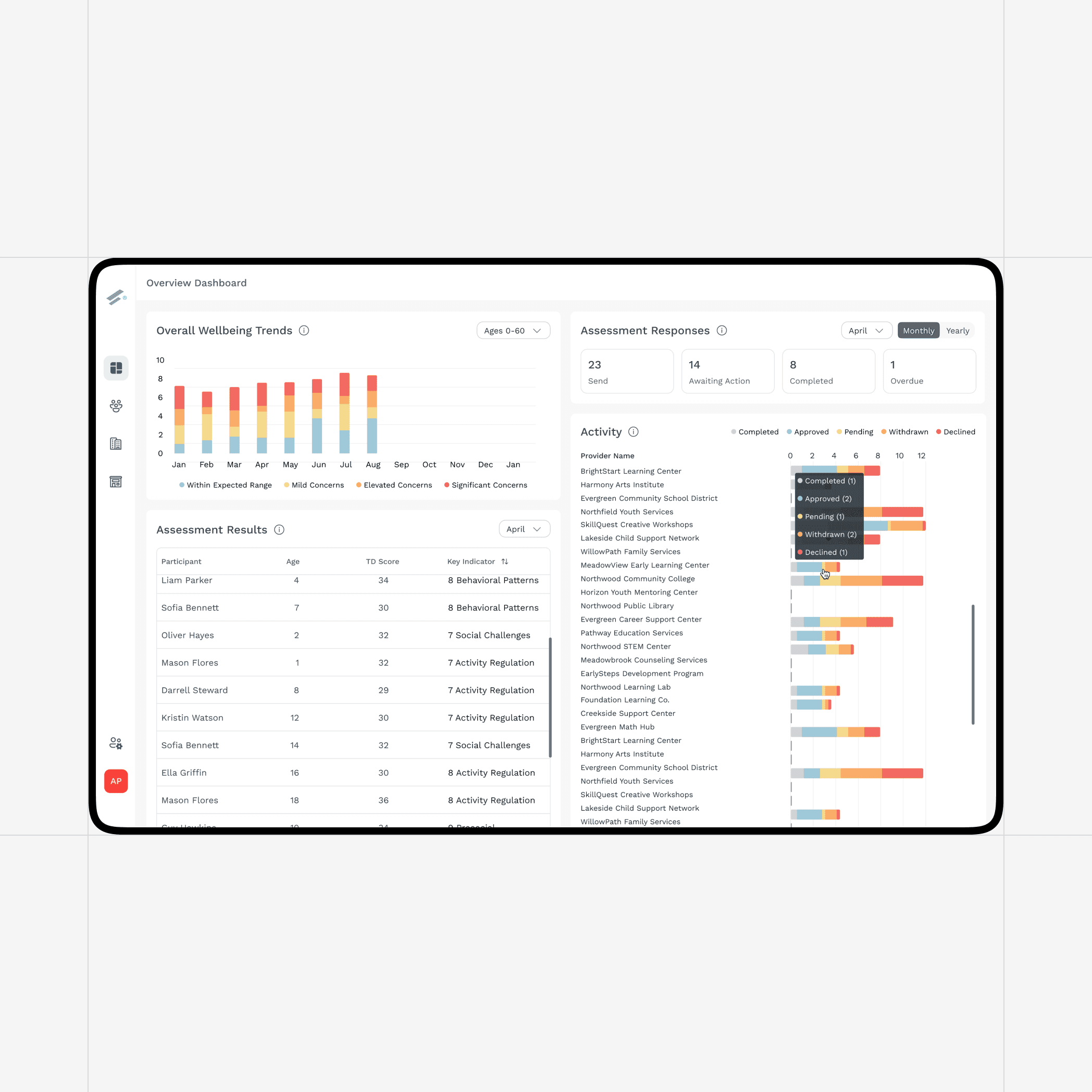
Automating Human Services Case Management with Azure
How we replaced fragmented manual workflows with a serverless, RBAC-secured platform built on Azure
More resources