
SHORT ANSWER
An AI agent or chatbot pilot typically takes four to eight weeks with a team of two to four people. Taking it to production typically takes another two to four months. Plan for monthly running costs too: model usage, hosting and monitoring. Data readiness, the number of connected systems and whether the agent acts or only answers drive the cost more than the model does.
You’ve seen an AI demo that took a weekend, and now you need a budget for one your staff will trust with real work. Those are different projects. A demo answers easy questions on clean data. A production agent handles messy data, permissions, edge cases and audits. This guide gives typical team sizes and timelines for each phase and shows what drives the cost.
What does an AI agent project typically cost?
Phase | What you get | Typical duration | Typical team |
|---|---|---|---|
Use case and data assessment | Prioritized use cases, data readiness, architecture | 1 to 3 weeks | 1 to 3 people |
Pilot | Working agent on real data for a small user group | 4 to 8 weeks | 2 to 4 people |
Production release | Security, connected systems, evaluation, monitoring | 2 to 4 months | 3 to 5 people |
Ongoing improvement | New tools, data sources and tuning | Ongoing, billed monthly | 1 to 3 people, often part time |
These are typical ranges and assume one well-defined use case. Several use cases, or agents that act in many systems, push you toward the upper end. Rates and budgets vary by engagement, so we don’t publish a price list. We scope each project and give you a direct quote. For a first estimate, multiply team size by duration by your partner’s rate, then add the running costs below.
Why do agents cost more than chatbots?
A chatbot answers. An agent acts: it calls APIs, updates records, sends messages or starts workflows. Every action needs permissions, a confirmation step where the risk is high, and an audit log. You also need tests for what the agent should refuse to do, not only what it should do. That extra work puts most agents in the upper half of the ranges above.
What does it cost to run an AI agent after launch?
Model usage: pay-per-token API costs, which depend on the number of users, the number of questions and how much context goes to the model.
Infrastructure: hosting, vector or graph databases, storage and logging.
Monitoring and evaluation: tools that track quality, cost and latency.
Maintenance: updating prompts, tools and data connections as your systems change.
What drives the price?
Data readiness. Clean, accessible and well-described data is the biggest factor. Scattered or low-quality data can add weeks of groundwork before the agent does anything useful.
Number of connected systems. Each system the agent reads from or acts in, such as a CRM, ERP or ticketing tool, adds build and test work.
Actions versus answers. Agents that take actions need permissions, confirmations and audit logs.
Accuracy requirements. Regulated or customer-facing use cases need larger evaluation sets and stricter guardrails.
Retrieval approach. Standard RAG costs less. GraphRAG costs more but handles relationship-heavy questions better.
Security and compliance. Private networking, data residency and access control add effort in regulated industries.
Of these, data readiness is the one teams underestimate most. Check early whether the records your agent needs are complete, current and reachable through an API, because fixing that later stalls the whole project.
Where the value shows up first
For a nonprofit human-services organization, the starting point wasn’t AI at all. Staff re-keyed data from third-party systems into spreadsheets, caregivers triggered questionnaires by hand, and there was no role-based access to sensitive records. We built a serverless platform on Azure: automated ingestion through Azure Functions, a central data store, role-based access, dashboards, and ML models called through APIs to give frontline staff recommendations in real time.
The estimated reduction in manual data entry time was 60 to 80 percent. The ML recommendations only worked because the data pipeline, access control and HIPAA requirements came first. If your agent idea depends on data that still lives in spreadsheets, budget for that groundwork before you budget for the model.
What does a realistic pilot plan look like?
A pilot should answer one question: does this agent save enough time or money, on real data, to justify production? A typical eight-week plan looks like this:
Weeks | Focus | Output |
|---|---|---|
1 to 2 | Use case, success metric, data access and evaluation set | A test set of real questions or tasks and a target accuracy |
3 to 5 | First working agent on real data, with retrieval and one or two tools | A version a small user group can try |
6 to 7 | Testing with users, error analysis, guardrails | Measured accuracy, cost per conversation and a list of failure cases |
8 | Decision review | Go, adjust or stop, with a production estimate |
Stopping after week eight is a valid outcome. A pilot that proves an idea won’t pay back has saved you the cost of a production build. Write the stop criteria down in week one, so nobody argues about them in week eight.
How do you keep an AI budget under control?
Pick one use case with a measurable outcome, such as time saved per request or tickets resolved.
Build an evaluation set of real questions before you build the agent.
Start with an existing model and retrieval, and only fine-tune if there’s a clear reason.
Plan security, access control and evaluation from week one. Leaving them out is a common reason pilots stall.
Track model cost per conversation from day one.
How RUBICON helps with AI agent projects
We start with a short assessment of the use case and the data, build a pilot on your real data, then take it to production with security, evaluation and monitoring in place. Our work includes an enterprise GraphRAG chatbot proof of concept and the case management automation on Azure described above.
Explore our AI agents service, or compare effort for other projects in how much custom software development costs in Europe. Budgets depend on the use case and the data, so we quote each project directly after the assessment. If you have a use case in mind, our engineers can help you scope a pilot.
Frequently asked questions
What is the difference between an AI chatbot and an AI agent?
A chatbot answers questions, usually from documents. An AI agent also takes actions: it calls tools and APIs, looks up records, fills forms or starts workflows, often across several steps. Agents need more connections to other systems, permissions and testing, so they typically cost more to build and to run safely.
How much does it cost to run an AI agent each month?
It depends on usage. Model API costs grow with the number of users, the number of questions and how much context each request sends. On top come hosting, vector or graph databases and monitoring. High-volume customer-facing agents cost more to run than internal assistants, which is why you should track cost per conversation from the first week and set a monthly budget alert.
Why do so many AI pilots never reach production?
Mostly because the data isn't ready, there's no clear success metric, and security, access control and evaluation weren't planned. A pilot built on a clean demo dataset rarely survives contact with real records. Planning for production from the first week, on real data, avoids most of these problems.
Do we need to train our own model?
Almost never for business agents. Most projects use existing models from providers such as OpenAI, Anthropic or Microsoft through Azure, combined with your data through retrieval and tools. Fine-tuning is only worth it for narrow, high-volume tasks where an off-the-shelf model can't reach the accuracy you need.
Related case study
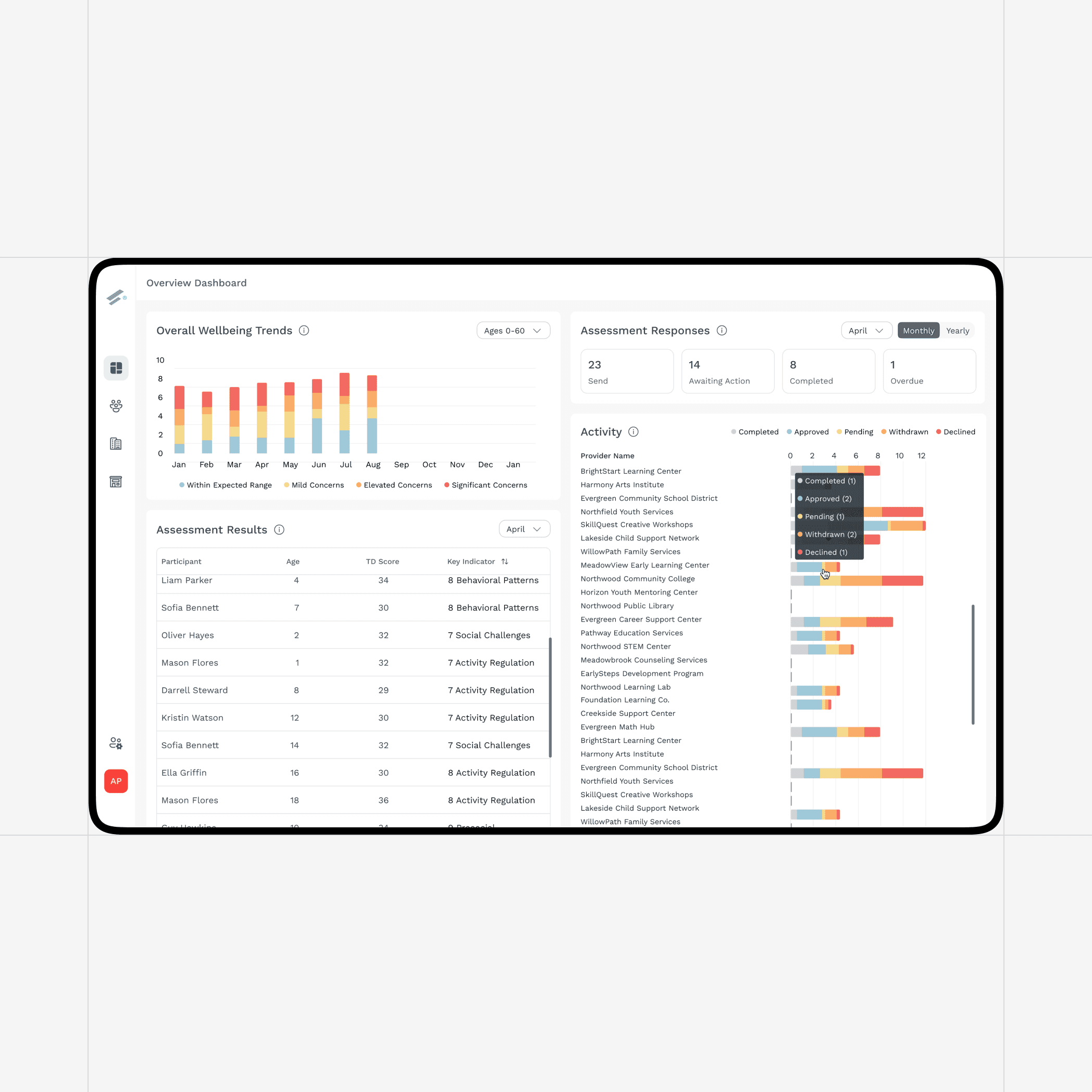
Automating Human Services Case Management with Azure
How we replaced fragmented manual workflows with a serverless, RBAC-secured platform built on Azure
More resources