
SHORT ANSWER
An enterprise data hub is a central platform that collects data from many source systems, governs it and serves it to reports, applications and AI through one access point, often an all-in-one analytics portal. Unlike a data lake, it adds curation and access control. Unlike a warehouse, it also serves raw and semi-structured data. A first version covering two to four sources typically takes 3 to 6 months.
An enterprise data hub is a central platform that pulls in data from many source systems, such as ERP, CRM, e-commerce, supply chain and finance tools, then cleans, governs and serves it through one point of access. That access point is often an all-in-one analytics portal where people find dashboards, datasets and data products in one place. If your departments report different numbers for the same metric, this is the problem a hub solves: one trusted version of the data instead of dozens of exports and spreadsheets.
What does a data hub actually do?
Connects sources. Batch and near-real-time ingestion from operational systems, files, APIs and third parties.
Standardises and curates. Cleans data, matches keys and definitions, and builds shared entities such as customer, product and site.
Governs. Catalogue, lineage, access control and data quality checks, so people know what data means and who may see it.
Serves. Publishes data to BI tools, applications, APIs and machine learning, often through a portal or marketplace.
Tracks usage. Shows which datasets and reports people use, which helps you prioritise work and retire duplicates.
Data hub vs. data lake, warehouse, lakehouse and data mesh
These terms overlap, and vendors use them loosely. The table shows the usual meaning of each.
Concept | What it is | Strength | Limitation |
|---|---|---|---|
Data lake | Low-cost storage for raw data in files | Holds any data at scale | Turns into a swamp without curation |
Data warehouse | Structured, modelled store for SQL and BI | Fast, reliable reporting | Less suited to raw, semi-structured and ML data |
Lakehouse | Lake storage with warehouse features (tables, transactions, governance) | One platform for BI and AI | Needs solid engineering and governance practices |
Data mesh | Operating model where domains own and publish data products | Scales ownership across large organisations | Needs mature domains and a strong platform team |
Enterprise data hub | Central platform that connects, governs and serves data to all consumers | One access point and one trusted version | Can become a central bottleneck if poorly organised |
In practice they aren’t alternatives. A typical modern hub runs on a lakehouse, uses a medallion architecture of bronze, silver and gold layers, and may adopt data mesh principles by letting domains own their data products on a shared platform.
What we see in delivery: finding data is the bottleneck
We built a data and analytics portal for a global chemical and consumer goods company whose data platform already followed a data mesh pattern. Storage wasn’t the problem. Analysts and data developers couldn’t see which data existed, and they depended on a few experts to find it and get access.
The portal became a single entry point. People browse data assets from the central catalogue, discover data products, request access through an automated flow with notifications for requesters and approvers, and follow learning paths for the analytics tools. Single sign-on handles login. The lesson for anyone planning a hub: budget as much attention for discovery and access requests as for pipelines, or the data stays locked behind the people who know where it is.
What does a typical data hub architecture look like?
Layer | Purpose | Common technology |
|---|---|---|
Ingestion | Load data from sources in batch or streaming | Azure Data Factory, Fabric pipelines, Databricks Lakeflow, Kafka, change data capture tools |
Storage and processing | Store raw and curated data, run transformations | Delta Lake or OneLake on cloud object storage, Spark and SQL |
Governance | Catalogue, lineage, permissions, quality | Unity Catalog, Microsoft Purview, data quality rules |
Semantic layer | Shared business definitions and metrics | Power BI semantic models, metric views, dbt |
Serving and portal | Dashboards, datasets, APIs and search in one place | Power BI, custom web portal, APIs, AI assistants |
Signs you need an enterprise data hub
Different departments report different numbers for the same metric.
Analysts spend more time finding and cleaning data than analysing it.
Reports depend on manual Excel exports that break when one person is on holiday.
You can’t answer cross-functional questions, such as margin by customer and channel, without starting a project.
You want to use AI on company data but have no governed place to point it at.
Access to sensitive data runs on shared files rather than rules.
If only one or two of these apply and you have few source systems, a well-designed warehouse or a single BI platform may be enough. A hub pays off when many sources meet many consumers.
How do you build one step by step?
Start with use cases. Pick three to five decisions or reports with clear business owners and value.
Map sources and definitions. Identify the systems involved and agree on key definitions, such as what counts as revenue.
Choose the platform. Decide between options such as Databricks and Microsoft Fabric based on skills, existing licences and workloads. See our Microsoft Fabric vs. Databricks comparison.
Build the first slice end to end. Ingestion, curation, governance and a working portal for the first use cases, typically in 3 to 6 months.
Add governance early. Catalogue, ownership and access rules from the first dataset, not after.
Grow by domain. Add sources and teams in increments, and measure adoption as you go.
What does an enterprise data hub cost?
A first increment typically needs a team of three to six people: data engineers, an architect, a BI developer and a part-time analyst or product owner. Rates and budgets vary by engagement, so we don’t publish a price list. We scope each hub after a short discovery and give you a direct quote. The table shows typical effort and what moves it.
Cost item | Typical effort | Main cost drivers |
|---|---|---|
Build team | Three to six people | Seniority mix, how many roles you need full time |
First release | 3 to 6 months for two to four sources | Number and quality of sources, governance depth, portal scope |
Cloud platform | Monthly, grows with usage | Data volume, compute, refresh frequency, existing licences |
Ongoing operations | A smaller team after go-live | New sources, new use cases, support hours |
To estimate a first release, multiply team size by duration by your partner’s rate, then add cloud costs. When you ask for a quote, check whether it covers QA, project management, data migration, cloud setup and maintenance after launch. Those are the costs that most often show up later. Plan the budget in increments, not as one project.
Common pitfalls
Trying to ingest every system before delivering a single useful report.
Treating the hub as an IT project without business owners for each dataset.
Skipping the semantic layer, so every report redefines the same metrics.
Building a portal nobody knows about. Adoption needs training and communication.
How RUBICON helps with enterprise data hubs
We build data platforms and analytics portals on Databricks, Azure and Fabric, from ingestion and governance to the portal people actually use. RUBICON is a Databricks Partner and a Microsoft Solutions Partner for Cloud & AI Platforms, ISO 27001:2022 and ISO 9001:2015 certified, and works from Sarajevo in the CET time zone with clients across Europe and North America. See our data engineering services and analytics and BI.
If you’re deciding where a first hub increment should start, our architects can look at your sources and use cases with you and give you a scoped estimate after a short discovery.
Frequently asked questions
What is the difference between a data hub and a data lake?
A data lake stores large volumes of raw data cheaply, usually as files on cloud storage, with little structure imposed. A data hub goes further: it curates, governs and publishes data for consumers, with a catalogue, access rules and defined datasets. Many modern data hubs use a data lake or lakehouse as their storage layer and add governance and serving on top.
Is a data hub the same as a data warehouse?
No. A data warehouse stores structured, modelled data built for reporting and SQL analytics. A data hub is broader. It connects and serves structured, semi-structured and sometimes streaming data to reports, applications, APIs and machine learning. A warehouse, or a warehouse-style gold layer, is often one component inside a data hub.
How long does it take to build an enterprise data hub?
A first version covering two to four source systems and a handful of priority reports typically takes 3 to 6 months. A broad hub serving most of the organisation usually grows over 12 to 24 months in increments. Starting with one business domain and a clear set of use cases is faster and less risky than connecting everything at once.
What does an enterprise data hub cost?
It depends on the number of source systems, their data quality, governance needs and data volume. A first increment typically needs three to six people for 3 to 6 months, so estimate it as team size × duration × your partner's rate. Cloud platform costs come on top and grow with data and compute. Rates vary by engagement, so we scope each hub and give a direct quote.
Related case study
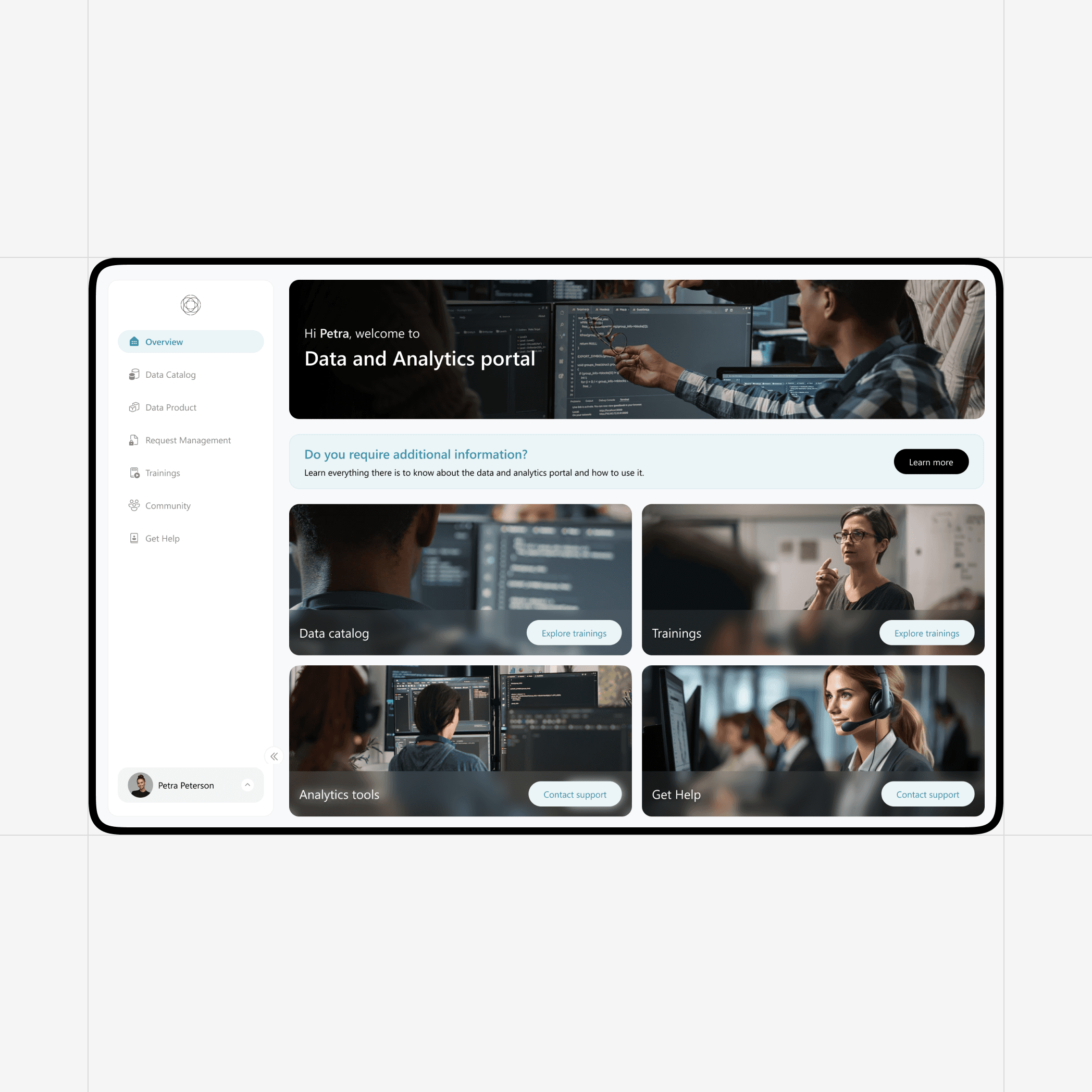
Enterprise Data Hub: All in One Analytics Portal
RUBICON delivers a comprehensive and secure cloud-based solution that serves as a single entry point for data consumers, bringing together all elements of data platform and analytics needs.
More resources