
SHORT ANSWER
Real-time supply chain analytics processes orders, stock movements, production output and shipment events within seconds to minutes instead of overnight, so planners can act before a stock-out or late delivery happens. Most supply chain decisions need updates every 1 to 15 minutes, not sub-second streaming. A first production use case typically takes 3 to 6 months with three to five people. Source systems and latency drive the cost most.
Your planners see yesterday’s stock. By the time a report shows that a distribution centre is short on a fast-moving product, the trucks have already left. Real-time supply chain analytics closes that gap by processing order, inventory, production and shipment events within seconds to minutes. This guide covers which use cases pay off first, the reference architecture, how much latency you actually need, what drives the cost and how to start.
Why is overnight batch reporting no longer enough?
Most supply chain reports refresh once a day. That’s fine for a monthly review. It fails when margins are thin, lead times are short and customers expect a delivery date they can trust. The case for real time is simple: the problem shows up while someone can still fix it.
Which use cases pay off first?
Use case | What it does | Typical latency needed |
|---|---|---|
Inventory visibility | Shows stock by location, in transit and reserved, across sites | 1 to 15 minutes |
Stock-out and overstock alerts | Flags products at risk based on current demand and stock | 5 to 15 minutes |
Shipment tracking and ETA | Combines carrier updates and order data to predict late deliveries | 1 to 5 minutes |
Production monitoring | Tracks output, downtime and quality against plan | Seconds to 1 minute |
Order promising | Gives customers a reliable delivery date at order time | Seconds |
Supplier performance | Monitors on-time, in-full delivery as receipts are posted | 15 to 60 minutes |
Most teams start with inventory visibility or delivery alerts. Both use data you already hold in the ERP and warehouse system, and the operations team feels the difference within weeks.
What we learned replacing an off-the-shelf supply chain tool
A global consumer goods company asked us to replace an off-the-shelf supply chain tool that was expensive to run and slow to query. Planners needed to filter a supply network dataset of 40 million rows and see the result on a world map in near real time. We started with a proof of concept to test storage and query choices before anyone committed to a full build. It took three months, and the first platform version went live by the end of the same year.
Query performance improved 10x, and more in some cases, compared with the software it replaced. The lesson we’d pass on: prove the serving layer on your real data volume first. In near real-time analytics, most of the risk sits in how fast the store answers filtered queries, not in the pipelines that feed it.
What does the reference architecture look like?
Layer | Role | Common options |
|---|---|---|
Sources | ERP, WMS, TMS, carrier APIs, IoT sensors, e-commerce | SAP, Microsoft Dynamics, custom systems |
Capture and transport | Stream changes and events as they happen | Change data capture, Kafka, Azure Event Hubs |
Processing | Clean, join and enrich streams, compute metrics and rules | Spark Structured Streaming, Databricks Lakeflow, Fabric Real-Time Intelligence |
Storage | Keep history and current state in open tables | Delta Lake or OneLake, organised by medallion layers |
Serving | Dashboards, alerts, APIs, planning tools | Power BI, custom portals, email or Teams alerts, APIs |
Governance | Access control, lineage, data quality | Unity Catalog, Microsoft Purview |
The key design choice is to keep streaming and batch data in the same lakehouse tables. A live dashboard and a monthly analysis then use the same definitions, and the history you collect can train forecasting models that score new events as they arrive. A separate streaming stack usually ends with two versions of every metric and a meeting to decide which one is right.
Do you need real time, near real time or batch?
Sub-second streaming costs more to build and run than micro-batches every few minutes. A practical rule:
Seconds: machine and sensor data, order promising, warehouse automation.
1 to 15 minutes: inventory, shipments, alerts for planners. This covers most supply chain needs.
Hourly or daily: supplier scorecards, financial reporting, long-range planning.
Set latency per use case, not for the whole platform. Streaming everything continuously is the most common reason running costs grow faster than the value people get from the data.
What does real-time supply chain analytics cost?
Item | Typical effort | Main cost drivers |
|---|---|---|
First production use case | 3 to 6 months | Number and quality of source systems, ERP connections in particular |
Team for first release | 3 to 5 people: data engineers, architect, BI developer, part-time product owner | Seniority mix, how much of the team works full time |
Platform running costs | Monthly, grows with event volume | Latency, how many streams run continuously, BI licences |
Each additional use case | Usually shorter than the first | How much of the platform, data and definitions it can reuse |
Rates and budgets vary by engagement, so we don’t publish a price list. We scope each project and give you a direct quote. To estimate a first use case yourself, multiply team size by duration by your partner’s rate, then add running costs. Ask whether a quote covers QA, project management, cloud setup, monitoring and support after go-live, because those costs tend to appear later.
How do you get started?
Pick one decision. For example, which orders will ship late today, and who needs to know.
Check the data. Confirm that the events you need exist and can be captured, and measure their quality.
Build a proof of concept. Two to six weeks is often enough to show live data on a dashboard with a few alert rules.
Harden for production. Add monitoring, error handling, security and governance.
Measure the impact. Track metrics such as stock-outs, expedited freight costs or on-time delivery before and after.
Extend. Add use cases on the same platform, and consider forecasting or a supply chain digital twin later.
What are the common pitfalls?
Streaming everything before a single decision has been improved.
Ignoring master data quality, so product and location codes do not match across systems.
Dashboards without owners, so alerts go unanswered.
A separate streaming stack that duplicates definitions from the main data platform.
How RUBICON helps with real-time supply chain analytics
We’ve built near real-time supply chain platforms for chemical and consumer goods companies, from proof of concept to production, and you can read about those projects on our cases page. We’re about 55 people, 40+ engineers, a Databricks Partner and a Microsoft Solutions Partner for Cloud & AI Platforms, ISO 27001:2022 certified and working in CET with clients across Europe and North America.
Our data engineering team usually starts with one decision and the data behind it. If you’re weighing where real time would pay off in your supply chain, our architects can look at your setup with you and give you a scoped estimate after a short discovery.
Frequently asked questions
What is real-time supply chain analytics?
It's the continuous processing of supply chain events, such as orders, stock movements, production output and shipment updates, with a delay of seconds to minutes. Instead of reports that show yesterday, planners and operators see what is happening now. They get alerts when something needs action, for example a stock-out risk at one site or a truck that will miss its delivery slot.
Do I need true real time, or is near real time enough?
For most supply chain decisions, near real time (updates every 1 to 15 minutes) is enough and costs far less to run than sub-second streaming. True streaming pays off for warehouse automation, IoT sensor monitoring and live order promising. Decide latency per use case rather than for the whole platform, and revisit it once you see how people act on the data.
Which data sources are needed for supply chain analytics?
The core sources are the ERP (orders, inventory, production), the warehouse management system, the transport management system or carrier APIs, and demand data such as point-of-sale or e-commerce orders. Many companies add supplier portals, IoT sensors and external data such as weather or traffic. Change data capture is the usual way to stream ERP changes without loading the source system.
How much does a real-time supply chain data platform cost?
A first production use case typically needs three to five people for 3 to 6 months, so estimate the build as team size × duration × your partner's rate. Running costs for streaming compute, storage and BI licences come on top and grow with event volume and how many streams run continuously. The number of source systems and the latency you need move the total most.
Related case study
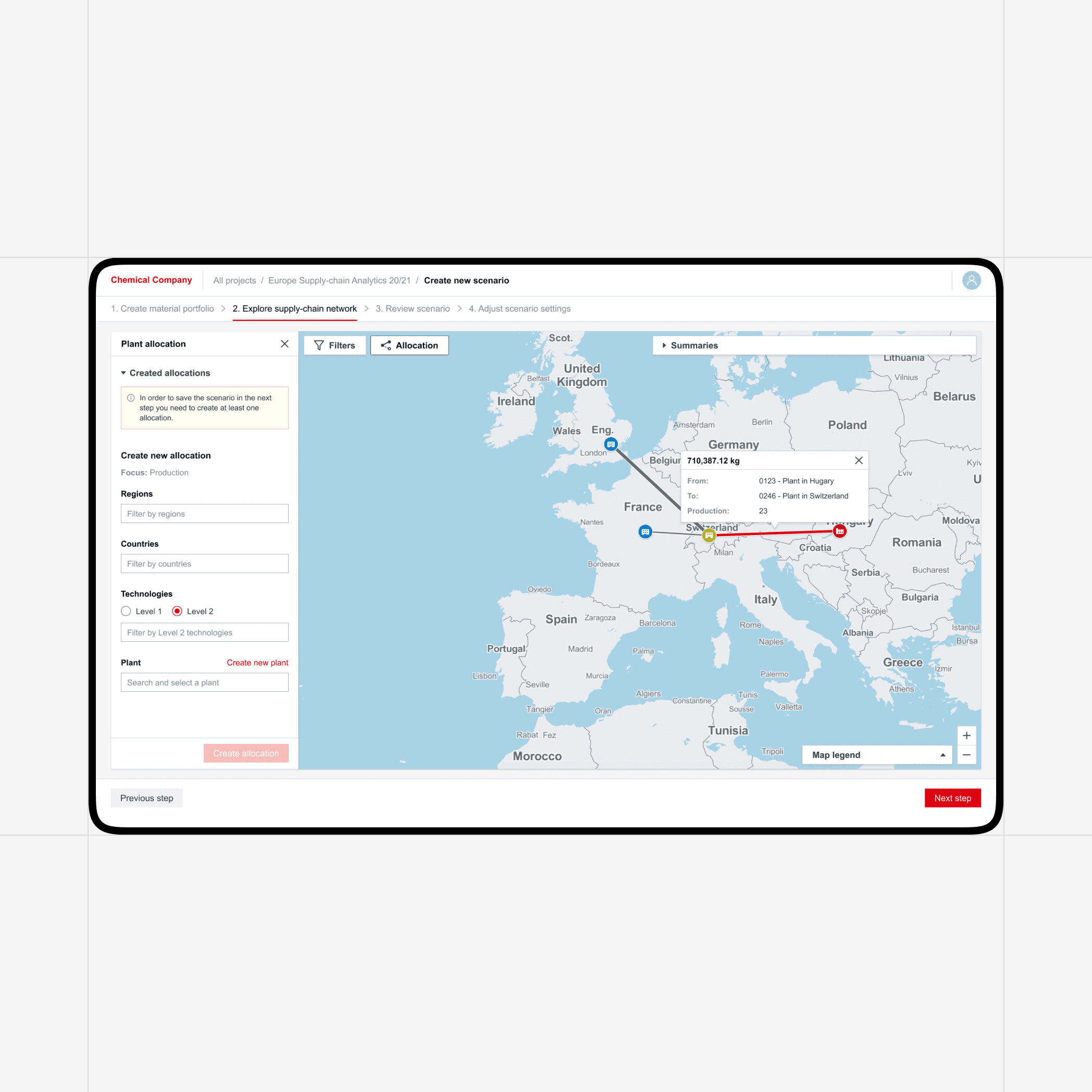
Real Time Analytics for Supply Chain Optimization
RUBICON Develops a Custom Real-Time Operation Analytics Supply Chain Management (SCM) Platform for a Global Client
More resources