
SHORT ANSWER
A Digital Product Passport (DPP) is a machine-readable record of a product's identity, composition, environmental performance and compliance, reached through a data carrier such as a QR code. The ESPR (Regulation (EU) 2024/1781) and sector laws require it. The battery passport applies from 18 February 2027. ESPR product rules start with steel from around 2028 and textiles and tyres from around 2029.
Your customers and regulators will soon expect a product-level data record for what you sell, linked to the physical product through a data carrier such as a QR code. A Digital Product Passport tells customers, recyclers and authorities what a product is, what it contains and how it performs environmentally. For chemical and consumer goods companies it’s mostly a data engineering problem: the information exists, but it sits in PLM, ERP, LIMS, supplier portals and spreadsheets, and rarely per product or per batch. This guide is general information, not legal advice.
What is the legal basis for the Digital Product Passport?
The main basis is the Ecodesign for Sustainable Products Regulation (ESPR, Regulation (EU) 2024/1781), in force since 18 July 2024. The ESPR only sets the framework. The concrete requirements, including whether a passport is needed and what it must hold, come in a delegated act for each product group.
Several sector laws also require passports on their own timelines: the Battery Regulation (EU) 2023/1542, the new Toy Safety Regulation (EU) 2025/2509, the Detergents and Surfactants Regulation (EU) 2026/405 and the Construction Products Regulation (EU) 2024/3110.
Which product groups need a DPP and when?
The Commission’s ESPR working plan for 2025 to 2030, adopted in April 2025, lists the first priority groups with indicative dates for delegated acts. Public trackers reported that no product-specific ESPR delegated act had been adopted by late summer 2026, and dates can move. Treat the table as planning guidance, not fixed deadlines.
Product group | Legal basis | Status as of September 2026 | Likely first obligations |
|---|---|---|---|
EV, LMT and industrial batteries over 2 kWh | Battery Regulation | Date fixed in the regulation | 18 February 2027 |
Iron and steel | ESPR delegated act | Planned for adoption in 2026 | Around 2028 |
Textiles (apparel), tyres, aluminium | ESPR delegated acts | Planned for adoption in 2027 | Around 2029 |
Furniture | ESPR delegated act | Planned for 2028 | Around 2030 |
Mattresses | ESPR delegated act | Planned for 2029 | Around 2031 |
Detergents and surfactants | Regulation (EU) 2026/405 | Adopted, in force March 2026 | From 2029 |
Toys | Regulation (EU) 2025/2509 | Adopted, in force January 2026 | 1 August 2030 |
Chemicals, paints, lubricants | ESPR (future) | Not in the first working plan, candidates for later study | Not yet scheduled |
Two related ESPR dates have already passed. Since 19 July 2026, large companies may not destroy unsold apparel, clothing accessories and footwear (medium-sized companies from 2030), and the Commission was due to set up the central DPP registry by the same date. The EU simplification packages of 2025 and 2026 changed sustainability reporting and battery due diligence (now from 18 August 2027) but did not move the battery passport date.
What does the battery passport require?
From 18 February 2027, each EV battery, light means of transport battery and industrial battery above 2 kWh placed on the EU market needs an electronic record reachable through a QR code. It covers general manufacturing information, composition including hazardous substances and critical raw materials, carbon footprint, recycled content, performance and durability, and dismantling and safety information.
Access is tiered. Some data is public, and some is only for authorities and people with a legitimate interest, such as repairers and recyclers. The battery passport is the best preview you’ll get of what ESPR passports will look like.
What data items will companies need?
Identity: unique product identifier at model, batch or item level, GTIN or equivalent, commodity (TARIC) code.
Actors: manufacturer, importer and responsible economic operator with unique operator identifiers, plus unique facility identifiers for production sites.
Compliance: declaration of conformity, technical documentation references, certificates, safety information and instructions for use.
Composition: materials, substances of concern with concentration and location in the product, critical raw materials.
Environmental performance: carbon or environmental footprint, recycled content, energy use, durability and repairability scores.
End of life: disassembly, repair, spare parts, collection and recycling instructions.
For chemical companies, substances of concern are the critical item. The ESPR requires them to be tracked through the product life cycle, so downstream customers will ask you for structured, product-level composition data instead of safety data sheets in PDF. Carbon footprint data connects directly to the work in our automated ESG reporting guide.
What data architecture does a DPP need?
Element | What it means | Standard or rule |
|---|---|---|
Identifiers | Globally unique, persistent IDs for product, operator and facility | EN 18219, GS1 identifiers are widely used |
Data carrier | QR code, data matrix or RFID on the product, packaging or documentation | EN 18220, defined per delegated act |
Storage and persistence | Hosted by the operator or a service provider, with a backup copy and availability for the product’s life | EN 18221, ESPR Article 10 |
Access rights | Different views for the public, professionals and authorities | EN 18239, defined per delegated act |
Exchange and APIs | Machine-readable, interoperable formats served over APIs | EN 18216, EN 18222, EN 18223 |
Integrity | Authentication and protection against tampering | EN 18246 |
CEN-CENELEC JTC 24 published these eight European standards in 2026, and six had been cited in the Official Journal by July 2026, which gives a presumption of conformity. In practice a DPP needs a product data hub that joins master data, bills of materials, supplier declarations and footprint calculations, versions them per batch and publishes each passport through an API. An enterprise data hub built on a lakehouse is a common foundation.
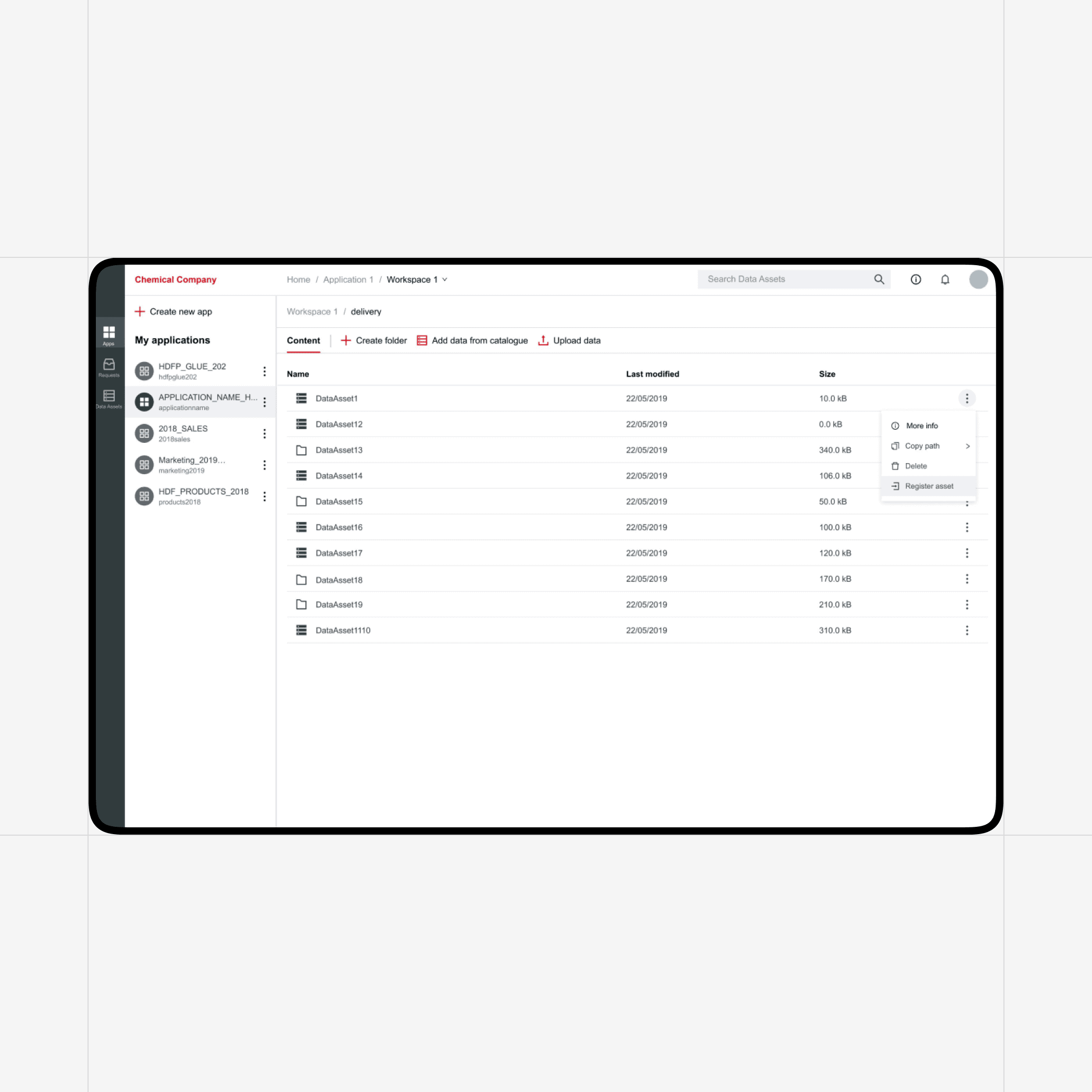
We’ve built that kind of foundation before. For a global chemical and consumer goods company, we delivered a data lake portal on Azure where employees and partners find, request and share data. It was designed for at least 1,000 peak users in parallel and more than 10 million files, with 30,000 new files a day, and it keeps audit logs of every user access and action. A four-day Lean Inception workshop fixed the scope before development, and the portal was in use after 7 months. A passport needs the same pieces: one place to find product data, approval workflows for access and an audit trail.
How should companies prepare?
Map your exposure: list the product groups, markets and customers affected, including customers who will ask you for passport data.
Run a data gap analysis: compare the likely data items with what PLM, ERP, LIMS and supplier systems hold today, and at which granularity.
Fix identifiers first: agree on product, batch and facility identifiers and a data carrier strategy with your packaging teams.
Collect supplier data in structured form: replace PDF declarations with templates or APIs for composition, substances and footprint.
Build a pilot passport for one product line, ideally batteries or a product group with an early date, following the CEN standards.
Plan governance: data owners, approval workflows, audit trails and update rules for the product’s life.
How RUBICON helps with Digital Product Passports
We build data platforms for chemical and consumer goods companies, including a data lake portal and an enterprise data hub with an all-in-one analytics portal. We’re a Databricks Partner, a Microsoft Solutions Partner for Cloud & AI Platforms, ISO 27001:2022 certified and rated EcoVadis Top 35%. Our Sustainability Accelerator is a starting point for footprint and product data, and our chemical industry work shows where we’ve done this before.
If you want to see how far your product data is from a passport, our architects can run the gap analysis with you.
Frequently asked questions
When will the Digital Product Passport become mandatory?
It depends on the product. Batteries come first: EV, light means of transport and industrial batteries above 2 kWh need a battery passport from 18 February 2027. Under the ESPR, each product group needs its own delegated act, and obligations usually apply about 18 months after it. Based on the 2025 to 2030 working plan, first obligations are likely from around 2028 for steel and 2029 for textiles and tyres.
Do chemicals need a Digital Product Passport?
Most chemical substances and mixtures are not in the first ESPR working plan. Chemicals, paints, detergents and lubricants appear only as possible later candidates. The new Detergents and Surfactants Regulation (EU) 2026/405 does introduce a passport for detergents from 2029, and customers who make passport-regulated products will ask chemical suppliers for substance and composition data.
What data does a Digital Product Passport contain?
Typically a unique product identifier, GTIN or equivalent, manufacturer and operator identifiers, facility identifiers, conformity documents, instructions for use and safety, material composition, substances of concern, recycled content, carbon or environmental footprint, and repair, disassembly and end-of-life information. The delegated act for each product group sets the exact list.
Where is Digital Product Passport data stored?
The ESPR uses a decentralised model. The economic operator, or a DPP service provider acting for it, stores and serves the passport data. The Commission runs a central registry that holds identifiers and links rather than the full passport, and a third-party service provider must keep a backup copy. Customs and market surveillance authorities get access through the registry.
Related case study
Data Lake Portal for Chemical & Consumer Goods
Digital Transformation: RUBICON Develops a Secure Cloud Native Platform for a Global Chemical & Consumer Goods Company
More resources